The short answer
Visit independently for maximum time in the palace; choose a half-day tour when you want a guide, admission and transport between several Seoul stops.
Best forJoseon history, palace architecture and first-time Seoul visits
Time to allowPalace only: 2–3 hours; guided route: about 4 hours
Plan at a glance
| Best for | Joseon history, palace architecture and first-time Seoul visits |
|---|---|
| Time to allow | Palace only: 2–3 hours; guided route: about 4 hours |
| Decide first | Visit independently for maximum time in the palace; choose a half-day tour when you want a guide, admission and transport between several Seoul stops. |
| Ticketory options list | Compare Gyeongbokgung tours |
A short history
Gyeongbokgung was established in 1395 as the primary palace of the Joseon dynasty. Its position placed Bugaksan behind the complex and the ceremonial approach to Gwanghwamun before it. The palace was also connected with the creation and distribution of Hunminjeongeum, the script that developed into modern Hangul.
The complex was destroyed during the Japanese invasion of 1592 and restored in the nineteenth century. Much of it was dismantled during the colonial period; a long restoration programme began in the 1990s and continues to shape what visitors see today. Think of the palace as a restored historic landscape, not an untouched survival from one moment in 1395.
Why visit
Visit to read the hierarchy of a royal palace in space. The route from the main gate towards the throne hall establishes ceremony and authority, while residential quarters, ponds and pavilions reveal more private parts of court life. The scale is easier to understand when you leave time to cross the courtyards rather than rushing directly to one famous building.
Gyeongbokgung also works as an orientation point for central Seoul. The mountain backdrop, broad avenues and neighbouring museums help connect royal history with the modern capital. If you prefer detailed explanations and a route beyond the palace, the verified half-day tours add several city stops; if architecture is your priority, an independent visit gives you more control.
Tickets and tour options
The two verified Ticketory options are four-hour guided routes offered in the morning or afternoon. Both list admission fees and transportation as included, and both exclude lunch, drinks and hotel pickup or drop-off. They continue beyond Gyeongbokgung to Bukchon Hanok Village, or Namsangol Hanok Village when Bukchon is unavailable, then use the Bugak Skyway and finish around Gwangjang Market after a ginseng-centre stop.
These are multi-stop Seoul tours, not simple timed palace admission. Compare the part of the day that suits you, then confirm the exact meeting time and location shown on the final voucher. Ceremony schedules, individual stops and route details can change; do not book solely for one performance without checking the selected date.
| Option | Includes | Know before booking |
|---|---|---|
| Morning royal-palace tour (opens in a new tab) | Four-hour guided route with palace admission and transportation, plus the listed neighbourhood, viewpoint and market stops. | No lunch, drinks or hotel transfer. Confirm the voucher’s meeting time and substitute-stop conditions. |
| Afternoon royal-palace tour (opens in a new tab) | The same listed four-hour guided route, admission and transportation in an afternoon departure. | No lunch, drinks or hotel transfer. Confirm the voucher’s meeting time and the palace closing margin for your date. |
Ticket prices
For an independent visit, the official individual adult admission is KRW 3,000. On the official tariff, the foreign-adult category is ages 19–64; younger and older foreign visitors are among the listed free-admission groups, with evidence required where applicable. Rules and concessions can change, so check the official tariff for your party before relying on free entry.
Tour prices are separate from the palace gate price because they include guiding, transportation and additional stops. Use Ticketory to see the payable total for the chosen date and departure, then review currency, cancellation terms and visitor categories before paying. The listed tours already include admission, so do not add a separate palace ticket unless your confirmation specifically instructs you to.
Opening hours
Regular Gyeongbokgung hours are 09:00–17:00 from November to February, with last admission at 16:00; 09:00–18:00 from March to May and September to October, with last admission at 17:00; and 09:00–18:30 from June to August, with last admission at 17:30. The palace is normally closed on Tuesdays.
When the regular closure falls on a public or substitute holiday, the palace opens and closes on the next non-holiday instead. Special events, conservation work and official notices can alter access, so check the palace notice board close to the visit date. A tour departure time does not replace the venue’s operating calendar.
How to get there
For an independent visit, the official directions place Gyeongbokgung about a two-minute walk from Gyeongbokgung Station Exit 5 on Seoul Subway Line 3. Anguk Station Exit 1 on Line 3 and Gwanghwamun Station Exit 2 on Line 5 are listed as roughly six-minute walks. The address is 161 Sajik-ro, Jongno-gu, Seoul.
The verified guided tours meet in Myeongdong rather than at the palace gate. Treat the meeting point as part of the product: arrive at the exact location and time on the voucher instead of navigating directly to Gyeongbokgung. Hotel pickup and drop-off are not included, so plan the journey to and from the meeting area yourself.
What to look for
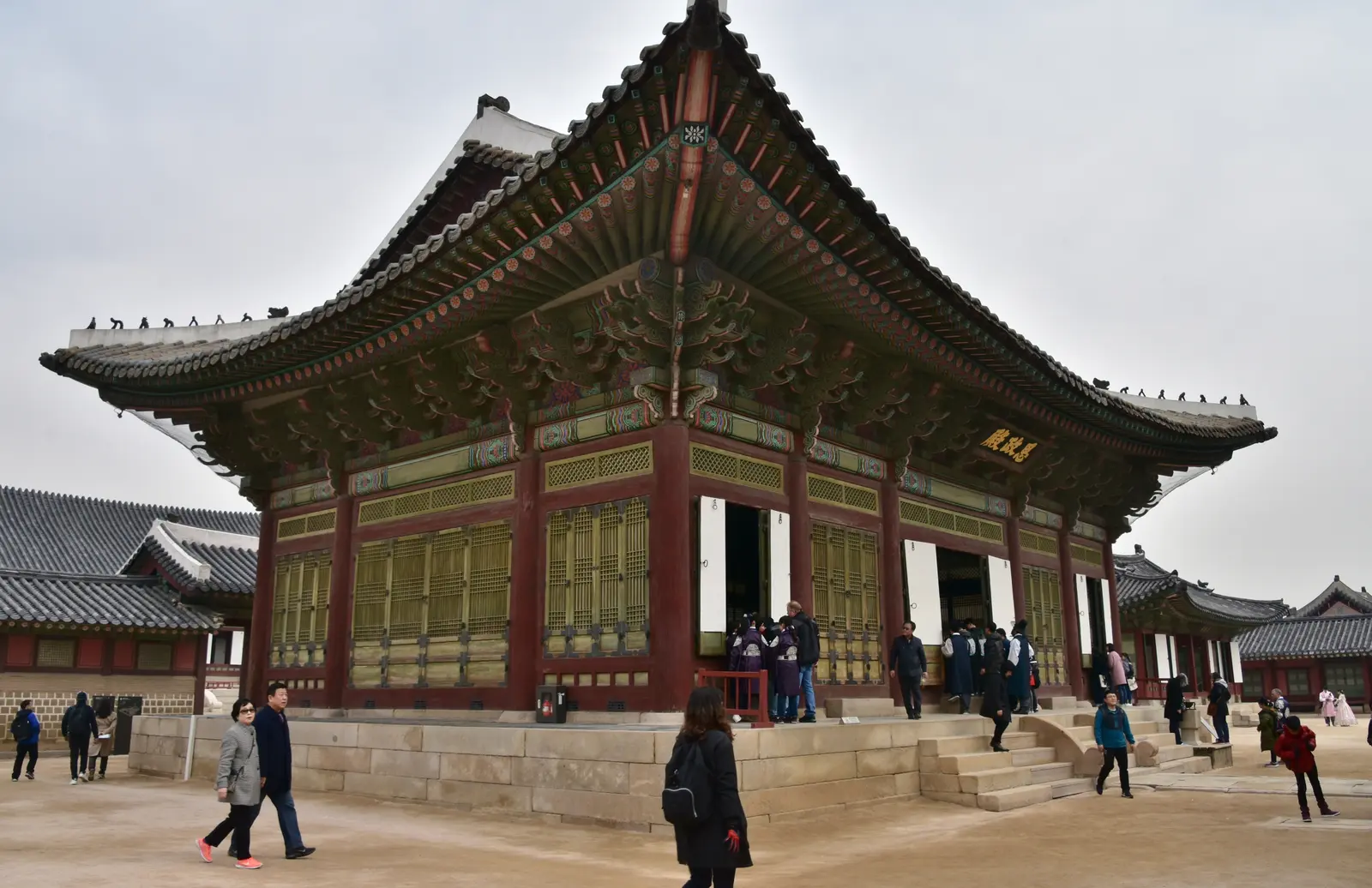
Begin with the ceremonial progression from Gwanghwamun through the inner gates to Geunjeongjeon, the throne hall. Then change pace: notice the roof lines, painted timber details and the way courtyards frame the mountains. Gyeonghoeru Pavilion beside its pond and Hyangwonjeong Pavilion offer a quieter contrast to the formal state buildings.
Do not let a changing-of-the-guard programme become the only reason for the visit. Ceremonies and access can change with weather or events. The palace itself remains the main attraction: choose a handful of spaces to examine closely, and use the official notices to identify temporary restrictions before setting a rigid route.
Practical tips
Wear comfortable shoes: even a selective palace route crosses large courtyards and uneven thresholds. Keep food and longer breaks for appropriate areas outside the historic interiors, follow barriers and staff instructions, and avoid assuming every pavilion can be entered. Save the official map or take a paper map at the entrance if available.
For a guided route, travel light and note that the day includes several stops rather than four continuous hours inside Gyeongbokgung. Lunch and drinks are excluded, and the route includes a commercial ginseng-centre visit. If that stop or the market finish does not suit your interests, an independent palace visit may be the better choice.
- Check Tuesday and holiday closure rules before booking transport.
- Keep the final tour voucher available offline.
- Allow a buffer before any later reservation in central Seoul.
How much time to allow
For the palace alone, our planning suggestion is two to three hours. That gives enough time for the main ceremonial route, selected residential areas and at least one pavilion without trying to inspect every corner. Add a separate break if you plan to continue into nearby museums or Bukchon on foot.
The verified guided products are listed as four-hour tours and include travel between multiple stops. Do not add another timed attraction immediately afterwards: traffic, walking pace and the final market stop can make a tight connection stressful. If palace architecture is your main interest, use the independent allowance instead of assuming a wider tour provides more time inside.
Winter tips
From November through February the palace closes at 17:00 and last admission is at 16:00. The broad courtyards are exposed, and daylight fades earlier than in summer, so start early enough to see the main route without racing the last-admission cutoff. A warm layer, gloves and shoes with reliable grip make the outdoor sections more comfortable.
Use indoor stops as optional breaks rather than assuming they share palace hours or admission. Snow, ice or maintenance can restrict surfaces and individual structures; follow barriers and current notices. For a half-day tour, confirm that the departure still fits the seasonal palace window and bring water even in cold weather, since drinks are not included.
Gyeongbokgung Palace: planning questions
What should I check before choosing Gyeongbokgung Palace?
The two verified Ticketory options are four-hour guided routes offered in the morning or afternoon. Both list admission fees and transportation as included, and both exclude lunch, drinks and hotel pickup or drop-off. They continue beyond Gyeongbokgung to Bukchon Hanok Village, or Namsangol Hanok Village when Bukchon is unavailable, then use the Bugak Skyway and finish around Gwangjang Market after a ginseng-centre stop. These are multi-stop Seoul tours, not simple timed palace admission. Compare the part of the day that suits you, then confirm the exact meeting time and location shown on the final voucher. Ceremony schedules, individual stops and route details can change; do not book solely for one performance without checking the selected date.
How much time should I allow for Gyeongbokgung Palace?
For the palace alone, our planning suggestion is two to three hours. That gives enough time for the main ceremonial route, selected residential areas and at least one pavilion without trying to inspect every corner. Add a separate break if you plan to continue into nearby museums or Bukchon on foot. The verified guided products are listed as four-hour tours and include travel between multiple stops. Do not add another timed attraction immediately afterwards: traffic, walking pace and the final market stop can make a tight connection stressful. If palace architecture is your main interest, use the independent allowance instead of assuming a wider tour provides more time inside.
How should I plan the journey to Gyeongbokgung Palace?
For an independent visit, the official directions place Gyeongbokgung about a two-minute walk from Gyeongbokgung Station Exit 5 on Seoul Subway Line 3. Anguk Station Exit 1 on Line 3 and Gwanghwamun Station Exit 2 on Line 5 are listed as roughly six-minute walks. The address is 161 Sajik-ro, Jongno-gu, Seoul. The verified guided tours meet in Myeongdong rather than at the palace gate. Treat the meeting point as part of the product: arrive at the exact location and time on the voucher instead of navigating directly to Gyeongbokgung. Hotel pickup and drop-off are not included, so plan the journey to and from the meeting area yourself.
Practical details can change. Check your selected Ticketory booking for current prices, opening arrangements, accessibility and entry instructions. Suggested timings and routes are our planning advice, not a guaranteed schedule.
Our editorial approach